01 / Overview

Northrop Grumman MQ-4C Triton: Eyes Above the Ocean

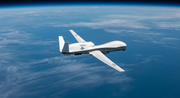
The Northrop Grumman MQ-4C Triton is a high-altitude, long-endurance (HALE) unmanned aircraft system developed under the U.S. Navy's Broad Area Maritime Surveillance (BAMS) program. It is the premier unmanned platform for real-time intelligence, surveillance, and reconnaissance over vast ocean and coastal regions.

Building on the airframe heritage of the RQ-4 Global Hawk, the Triton features reinforced wings, integrated de-icing systems, and lightning protection — allowing it to descend through cloud layers for closer observation of maritime targets.

Triton achieved Initial Operational Capability (IOC) with the U.S. Navy in 2023 and operates alongside the Boeing P-8A Poseidon as the core of the Navy's Maritime Patrol and Reconnaissance Force Family of Systems.

Mission Profile

Each Triton mission is orchestrated from a ground station crew of five: an Air Vehicle Operator, Tactical Coordinator, two Mission Payload Operators, and a SIGINT coordinator. The aircraft relays data in real time via satellite to commanders at sea and ashore.

Three operational orbits are currently active: Andersen Air Force Base (Guam), NAS Sigonella (Italy), and a U.S. Central Command detachment stood up in late 2024.

In September 2024, the Northrop Grumman MQ-4C Triton successfully demonstrated its navigation systems deep in the Arctic Circle — within 100 miles of the North Pole — validating its readiness for High North operations.
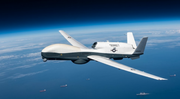
Northrop Grumman MQ-4C Triton unmanned aircraft system — HALE maritime surveillance drone overview page on MR1
📷 MR1 Photo

Northrop Grumman MQ-4C Triton — complete overview of the world's premier high-altitude, long-endurance unmanned maritime surveillance aircraft. The MQ-4C Triton operates at above 50,000 ft providing 24/7 ISR for the U.S. Navy. © MR1.com
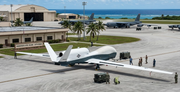
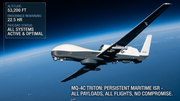
⚡ Breaking April 2026 — The U.S. Navy confirmed the loss of an MQ-4C Triton (valued at ~$240 million) near the Strait of Hormuz on April 9, 2026, classified as a Class A flight mishap. The cause — technical malfunction or external interference — is under investigation.
02 / Technical Specifications

Northrop Grumman MQ-4C Triton — By The Numbers

Parameter Value
DesignationMQ-4C Triton
ManufacturerNorthrop Grumman Corporation
TypeHigh-Altitude Long-Endurance (HALE) Maritime UAS
Program OriginBroad Area Maritime Surveillance (BAMS), U.S. Navy
First Flight22 May 2013 (BuNo 168457)
IOC2023 (U.S. Navy)
Altitude> 50,000 ft (15,240 m)
Endurance24+ hours
Range7,400 nautical miles (13,700 km)
Unit Cost~USD $240 million
Ground Crew5 per ground station (AVO, TACCO, 2× MPO, SIGINT)
Primary SensorAN/ZPY-3 MFAS (Multi-Function Active Sensor) — AESA radar
IntelligenceMulti-INT: Radar, EO/IR, SIGINT (IFC-4 / Multi-INT config)
Derived fromRQ-4 Global Hawk (Northrop Grumman)
Contract Value$1.16 billion (initial BAMS contract, April 2008)
OperatorsU.S. Navy (VUP-19), Royal Australian Air Force (No. 9 Sqn)
Northrop Grumman MQ-4C Triton technical specifications — altitude endurance range unit cost HALE UAV data
📷 MR1 Photo

MQ-4C Triton technical specifications — key performance data including 7,400 nm range, 50,000 ft+ altitude, and 24+ hour endurance that make the Northrop Grumman MQ-4C Triton unmatched in maritime ISR. © MR1.com

Northrop Grumman MQ-4C Triton capabilities — persistent maritime ISR AESA radar SIGINT multi-intelligence
📷 MR1 Photo

Northrop Grumman MQ-4C Triton capabilities — the multi-intelligence platform carries AESA radar, EO/IR, and SIGINT sensors simultaneously, enabling full-spectrum maritime domain awareness. © MR1.com

03 / Capabilities

What the Northrop Grumman MQ-4C Triton Does

Persistent Maritime ISR

24/7 wide-area ocean surveillance with 80% Effective Time on Station (ETOS), providing continuous situational awareness over thousands of square kilometers simultaneously.

AESA Radar Targeting

The AN/ZPY-3 MFAS active electronically scanned array detects, tracks, and classifies maritime targets with weapon-relevant accuracy from survivable standoff range.

SIGINT Collection

Multi-INT configuration (IFC-4) adds simultaneous signals intelligence alongside radar and EO/IR, providing layered sensor fusion from a single platform.

Missile Early Warning

Operates at altitudes above weather to provide unmatched persistent surveillance and early warning against maritime missile threats at extended range.

Search & Rescue

Ultra-long endurance and multi-sensor payload make Triton ideal for SAR coordination over vast ocean areas — locating and tracking survivors for hours without refueling.

Homeland Defense

Domain awareness and endurance make Triton ideal for wide-area Homeland Defense missions, monitoring coastlines and exclusive economic zones continuously.

Northrop Grumman MQ-4C Triton operators — US Navy VUP-19 and Royal Australian Air Force No. 9 Squadron
📷 MR1 Photo

The Northrop Grumman MQ-4C Triton is operated by the U.S. Navy's VUP-19 squadron and the Royal Australian Air Force No. 9 Squadron — sharing real-time ISR data across the Indo-Pacific, one of the world's most strategically critical regions. © MR1.com

04 / Operators

Who Flies Triton

🇺🇸

United States Navy

Primary operator and program lead. VUP-19 operates Triton from three orbits: Andersen AFB (Guam), NAS Sigonella (Italy), and a CENTCOM detachment stood up in fall 2024. IOC achieved in 2023.

Operationally Active
🇦🇺

Royal Australian Air Force

Four aircraft on order. No. 9 Squadron, re-raised in June 2023, operates Tritons from RAAF Base Edinburgh (South Australia) and RAAF Base Tindal (Northern Territory). First aircraft arrived June 16, 2024. Three now in service.

Operationally Active

India — Northrop Grumman has proposed the Northrop Grumman MQ-4C Triton to the Indian Navy as a complement to its twelve Boeing P-8I Poseidon maritime patrol aircraft.   United Kingdom — A reported 2014 interest in 8+ aircraft to replace the cancelled BAE Nimrod MRA4 was not formalized.

Northrop Grumman MQ-4C Triton program history timeline — BAMS contract first flight IOC milestones 2008 to 2026
📷 MR1 Photo

Complete program history of the Northrop Grumman MQ-4C Triton from the 2008 BAMS contract award through first flight in 2013, Initial Operational Capability in 2023, and the April 2026 Strait of Hormuz incident. © MR1.com

05 / Program History

Key Milestones

2008
April — Northrop Grumman awarded $1.16B BAMS contract. GAO upholds Navy selection over Lockheed Martin protest.
2010
September — BAMS aircraft officially designated MQ-4C.
2012
June 14 — Official unveiling at Palmdale, California. Aircraft named "Triton."
2013
May 22 — First flight of MQ-4C (BuNo 168457). Test flights at Edwards AFB and NAS Patuxent River.
2020
Two Tritons with early operational capability hardware begin operating in the Pacific.
2021
July — First flight of Multi-INT (IFC-4) configuration, dramatically improving SIGINT capabilities.
2023
U.S. Navy achieves Initial Operational Capability. RAAF No. 9 Squadron re-raised to operate Triton.
2024
June 16 — First RAAF Triton arrives in Australia. September — Arctic Circle navigation demonstration within 100 mi of North Pole.
2026
April 9 — U.S. Navy confirms loss of one MQ-4C (~$240M) near the Strait of Hormuz. Class A mishap investigation underway.